Our Services
RunDigi accompanies digital projects from architecture to stable operation.
What RunDigi delivers
Architecture & Enablement
Consulting, training & implementation
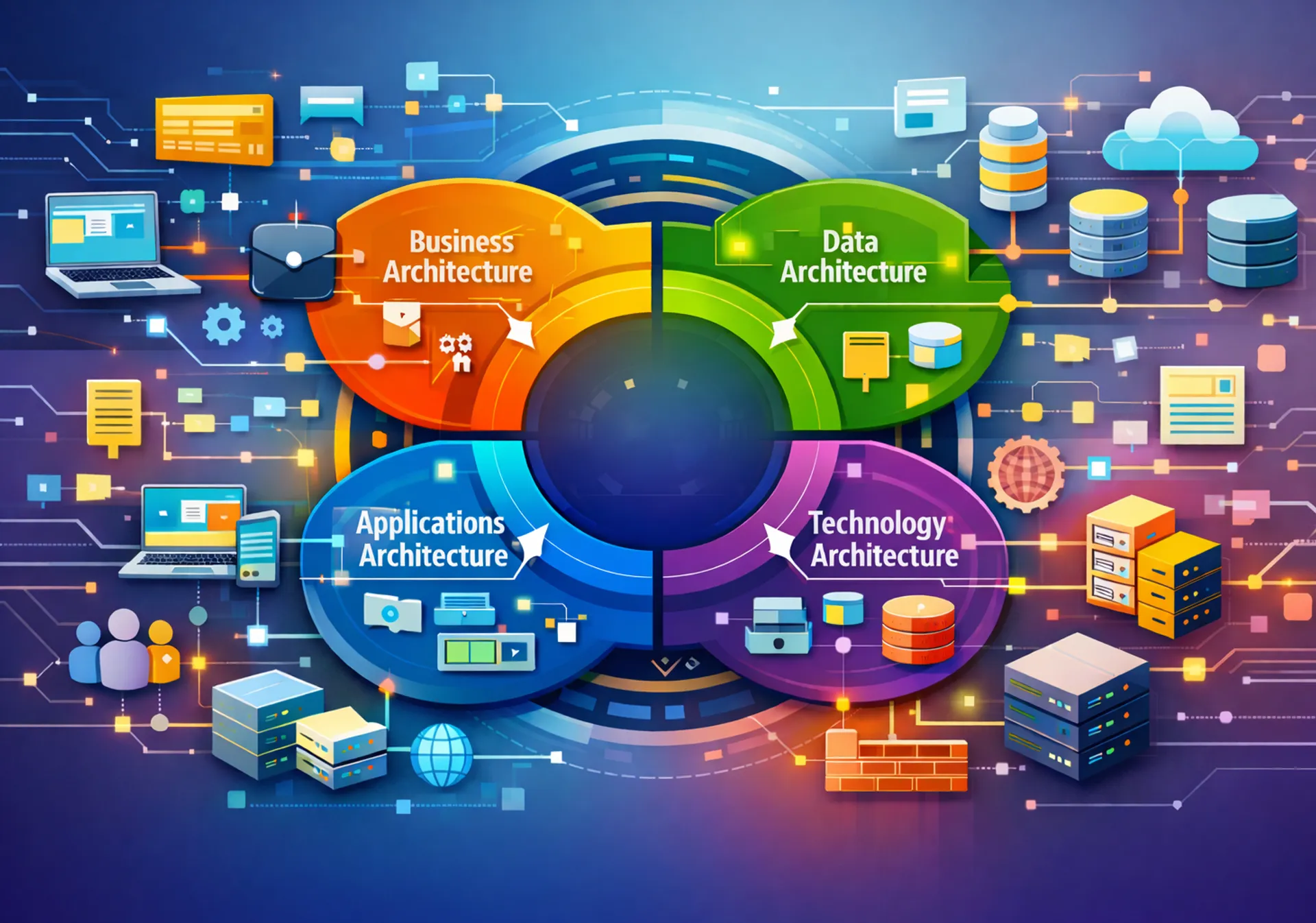
Our services in the area of architecture and enablement are aimed at companies that want to sustainably build and strengthen their enterprise architecture capabilities and link them to real business results. This involves not only methodological knowledge, but also practical application, governance, and organization-appropriate implementation.
We support your teams with targeted training and workshops – both on TOGAF 10 and on the essential principles and practices of enterprise architecture. Our training courses are offered in cooperation with experienced training institutes and can be conducted as public courses or in-house sessions . Especially with in-house training, we address real-world challenges and architectural situations within your company to generate immediate benefits.
Our enablement programs cover how to build enterprise architecture capability within your organization – including defining the roles, responsibilities, and governance processes necessary to sustainably embed architecture work. We demonstrate how architecture processes can be designed and integrated with other management disciplines such as project management, operations, and change management.
Another focus is the practical implementation and integration of architecture software and metamodels. We support you in building an enterprise architecture metamodel and establishing efficient data collection and analysis processes , enabling you to gain a complete "big picture" of your business. We consider integration with existing systems such as CMDBs and help you create a consistent and robust single source of truth.
In addition, we work with you to develop the strategic drivers and objectives underlying the implementation of an enterprise architecture. This includes formulating the right questions, aligning the metamodel accordingly, and identifying the resources and tools you need for successful architecture work. We help you define clear architectural principles and guidelines , and identify critical business components and capabilities that are essential for the strategic development of your company.

Integration and Automation
End-to-end for connected, smart businesses
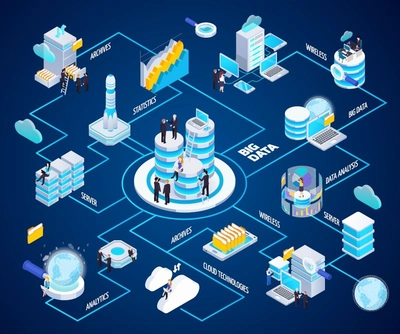
Time is one of a company's most valuable assets – and in an increasingly digitalized and networked world, the ability to integrate data quickly and effectively and to automate processes intelligently determines success or competitiveness.
We understand "integration and automation" as a holistic, end-to-end discipline: from structured data exchange between systems and orchestrated process automation to modern AI-supported workflows that largely automate complex manual processes. Technological efficiency alone is not the primary focus – rather, it's about leveraging human strengths where they are indispensable and relieving repetitive, error-prone routine tasks through robust automation solutions.
Integration is a fundamental issue even at the enterprise architecture level : data must be sourced from a wide variety of sources – be it a Configuration Management Database (CMDB) , business applications, or overarching data lakes. A well-designed enterprise architecture metamodel structures and meaningfully combines these elements, enabling them to serve as building blocks for efficient processes and automation logic.
Our approach is pragmatic, technology-agnostic, and practice-oriented:
- We support the analysis and collection of your professional and technical integration requirements.
- We are designing a robust integration and automation architecture that takes into account both existing systems and future strategies.
- We support the selection of suitable integration platforms, middleware, API solutions and automation stacks – also with a view to modern multi-cloud environments.
- In the implementation phase, we ensure that your integrations are secure, performant, and scalable, and that automation workflows remain traceable, maintainable, and operationally robust.
We rely on proven best practices such as API-first design, event-driven architecture, standardized data schemas, and modern integration patterns. For automation scenarios, we leverage the capabilities of low-code/no-code platforms, RPA (Robotic Process Automation), and AI assistance to make your processes more efficient – without relinquishing control.
Our goal is clear: you should be able to move your data seamlessly and securely between systems , orchestrate processes intelligently , and reduce repetitive work where technology creates real added value – while your team focuses on strategic, creative, and value-adding tasks.

Digital Platforms & Tools
Technology as the foundation for integration and automation
To truly and effectively implement a modern enterprise architecture, you need not only concepts, methods, and governance models, but also technological platforms and tools that make these concepts practically viable and support long-term scalability. We therefore consistently build on efficient, open, and proven technologies that help companies seamlessly connect their data, processes, and systems – both internally and with external partners.
One example of such a platform is n8n, a modern workflow and automation platform that can efficiently connect applications and systems in multi-cloud environments – from databases and SaaS tools to proprietary APIs – while enabling visual modeling of integration and automation processes. Its modular structure with nodes allows complex workflows to be mapped and automated without in-depth programming, while maintaining data sovereignty, self-hosting, and flexibility.
Such open platforms make it possible to implement integration workflows that go far beyond simple point-to-point scenarios: data can be synchronized, transformed and intelligently processed between different systems – be it for reporting, CRM synchronization or rule-based automation chains.
However, not every challenge can be solved with open-source tools alone. For specialized tasks, such as enterprise architecture tools, BPM engines, or iPaaS (Integration Platform as a Service) solutions, we rely on market-leading products designed specifically for this purpose. These platforms often include built-in governance features, extended API ecosystems, or deep cloud integrations, which play a crucial role in heterogeneous environments.
Our approach to selecting and introducing new tools is always goal-oriented and integration-focused:
- Requirements analysis and evaluation: Based on architecture and integration goals, we identify suitable platforms, taking into account data flows, interfaces and future viability.
- Deployment & Configuration: We provide support for operational rollout, the setup of workflows, API connections and automation logics.
- Integration into existing landscapes: Systems do not have to exist in isolation, but rather function as fully integrated components of a flexible, scalable architectural ecosystem.
The central goal is always to use new technologies as intelligent cogs in a larger machine: tools that not only simplify individual tasks but, together with other systems, enable true process and data automation. In doing so, they increase not only efficiency but also transparency and agility – without relinquishing control over data, security, or company rules.