

Future tech stack: Why we rely on Astro and Strapi for RunDigi
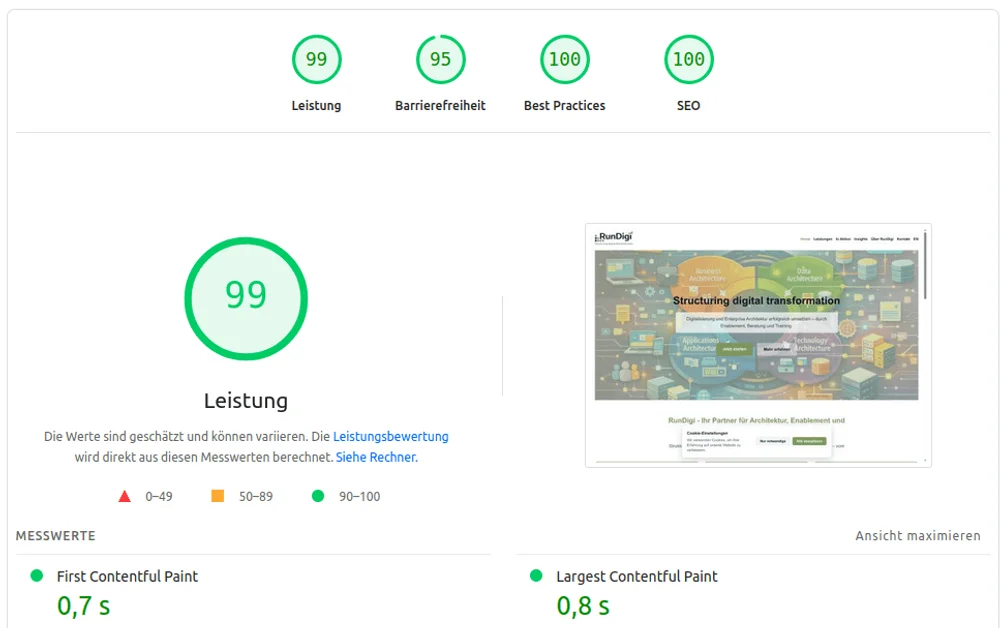
In today's digital landscape, speed is no longer just a bonus, but a business-critical requirement. When planning the new RunDigi website, I faced a clear choice: Do I rely on proven, monolithic systems like WordPress, or do I take the plunge and move towards a modern, decoupled architecture?
The search for lightweight design
Classic CMS templates are often overloaded with legacy code. They load unnecessary code, slow down performance with heavy database queries on every page load, and restrict design freedom with rigid structures. My goal was a system that is "lean by design". The search led me to the combination of Astro and Strapi – a dynamic duo that combines speed with maximum flexibility.
Headless CMS vs. Monolith: An Architectural Comparison
To understand why this stack is so efficient, one must consider the difference in architecture:
- Monolithic architecture (e.g., WordPress): The frontend (design) and backend (administration) are tightly integrated. Every change to the design also affects the system, and vice versa. This often makes maintenance complex and loading times slow.
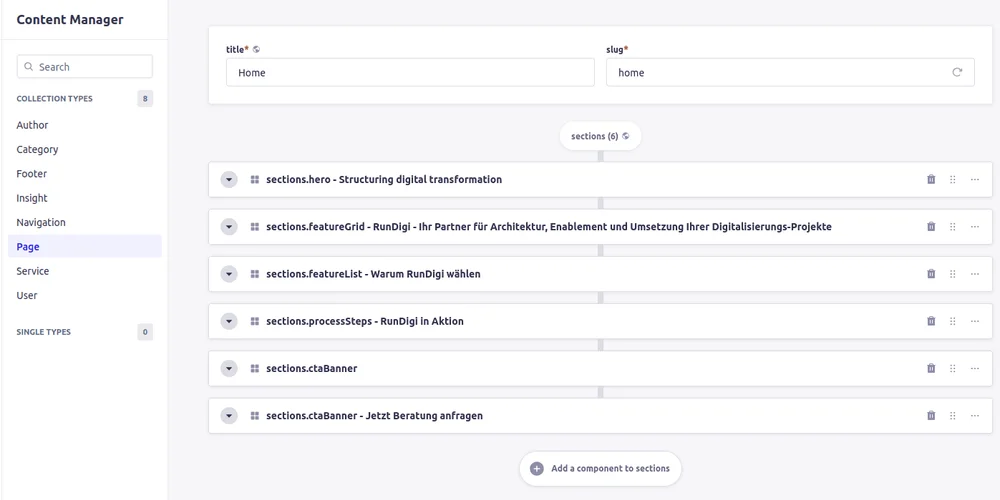
- Headless architecture (Strapi + Astro): The backend (Strapi) serves purely as a data source. The frontend (Astro) retrieves this data and uses it to build an independent, highly optimized website.
Strapi acts as our content hub – a modern, open-source, headless CMS. Astro, on the other hand, is the web framework that uses this data to generate lightning-fast, static HTML pages – without heavy, unnecessary JavaScript in the user's browser.
Behind the scenes: The RunDigi solution. To bridge the gap between ease of maintenance and technical excellence, we've focused on three key areas: Modular content builder: Instead of rigid page layouts, we use a component-based system. Content can be flexibly assembled from building blocks such as focused calls to action (CTAs), visual process steps, or optimized text-image combinations. Automated asset optimization: Unoptimized images are often a major obstacle. Our system handles this automatically: Images are converted into modern formats like WebP when the page is generated and provided in various sizes for mobile and desktop. Intelligent language linking: Multilingualism (German/English) is managed directly at the core. Automated logic ensures that search engine tags (hreflang) are always set correctly and that the translations remain linked accurately.
Conclusion: Freedom through open source and AI
Anyone wanting to get started with Strapi and Astro is leaving behind the world of rigid modular systems. Instead of building within a single system, you construct a customized solution using specialized tools. A modern tech stack demands precision – and here, the targeted use of AI support has massively accelerated development, especially for complex logic such as multilingual routing.
This freedom is essential: Open-source technologies like these allow us to use websites quickly, securely and highly efficiently, without becoming dependent on large platform providers.
Do you want to get started right away?
- Astro Documentation – The fastest way to get started with static websites.
- Strapi Quick Start Guide – Your own headless CMS in minutes.
See for yourself how good the performance is and browse rundigi.com. For questions or help with Astro and Strapi, use our contact form.